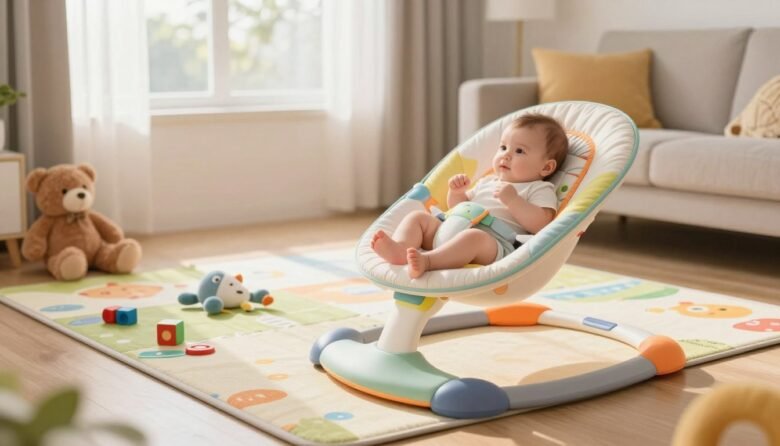
I remember the exact moment I understood what a baby bouncer was actually for. Claire was about six weeks old, I hadn’t showered in two days, and my partner needed to sleep. I needed both hands free for approximately twenty minutes. That was it. That was the whole requirement.
A bouncer isn’t magic. It won’t replace you, it won’t entertain your baby for hours, and it definitely won’t solve the underlying chaos of having a newborn. What it will do is buy you a window — twenty, maybe thirty minutes where your baby is safe, reasonably content, and not in your arms. For a new dad running on no sleep, that window is everything.
What a Bouncer Actually Does
Most baby bouncers work on a simple principle: the baby’s own movements create gentle bouncing, which most newborns find soothing. There’s no motor, no batteries, no app. The baby kicks, the seat moves, the baby calms down a little. It’s not complicated, and that simplicity is part of why it works.
The alternative is a motorized swing, which runs on batteries or a power cord and provides continuous automated motion. Swings tend to be bulkier, heavier, and more expensive. Some babies love them. Claire didn’t particularly care for ours — she preferred the responsive feel of a bouncer where her own movement drove the motion. Your baby may be completely different. This is one of those categories where you genuinely can’t know until you try.
What to Look For
Before you get lost in reviews and comparison charts, here are the things that actually matter in daily use.
Weight and portability. You will move this thing constantly — kitchen to living room to bathroom to wherever you happen to be. A bouncer that weighs five pounds is something you’ll pick up with one hand while holding the baby with the other. A bouncer that weighs twelve pounds is something you’ll resent by week three.
Washable fabric. Non-negotiable. Babies spit up. Babies have blowouts. Whatever cover is on that seat needs to come off and go in the washing machine without requiring an engineering degree to reassemble. Check this before you buy anything.
A secure harness. Three-point minimum. You’ll be stepping away — briefly, but still — and the harness is what keeps a squirmy baby from sliding or tipping. Make sure you can fasten and unfasten it one-handed, because your other hand will frequently be occupied.
Recline positions. Newborns need a more reclined position than older babies. A bouncer with multiple recline settings will last longer and work better across the first several months.
Foldability. If you live in a small space, or if you plan to travel with it, check whether it folds flat. Some do, some don’t, and the ones that do are significantly more practical.
The Toy Bar Question
Many bouncers come with an attached toy bar — a little arch with hanging toys above the baby’s face. For the first couple of months, this is mostly decoration. Newborns can’t really interact with it in any meaningful way. By month three or four, when your baby starts batting at things intentionally, a toy bar becomes genuinely useful for keeping their attention.
If you’re buying for a newborn, don’t let the toy bar be a deciding factor. If you want longevity out of the purchase, it’s a nice addition. Some toy bars are removable, which is ideal — you get the option without being stuck with it permanently.
One Thing Nobody Tells You
A bouncer is not a sleep surface. I know it’s tempting — your baby falls asleep in it, they look comfortable, and moving them feels like defusing a bomb. But the reclined position in a bouncer is not safe for extended or unsupervised sleep. Use it for awake time and supervised rest. When the baby is out, move them to a firm, flat sleep surface.
Also: check the weight limit before you buy, and again when you think your baby might be getting close. Most bouncers have a limit around 20 pounds or when the baby can sit up unassisted — whichever comes first. Once either of those happens, the bouncer is done.
Is It Worth It?
Yes. Unambiguously yes. A good bouncer is one of the more practical purchases you’ll make in the first year. It doesn’t take up much space, it doesn’t require batteries, and it earns its place in your home within the first week.
Claire spent a lot of time in hers while I made coffee, ate something that wasn’t a granola bar, or just stood in the kitchen for a few minutes doing absolutely nothing. That nothing was important. The bouncer made it possible.
Buy a simple, lightweight one with a washable cover and a solid harness. You don’t need the premium version with Bluetooth connectivity and twelve motion settings. You just need something that works and doesn’t break after a month. That’s the whole bar.
The Bottom Line
A baby bouncer is not glamorous gear. Nobody’s going to ask you about it at a dinner party. But somewhere around week three, when you need to take a shower and you need somewhere safe to put your baby while you do it, you’ll be very glad you have one. Get it before the baby arrives. Set it up. And then use those twenty minutes wisely.

Dad. Engineer. Survivor of the first year. I’m James Calloway, and my daughter Claire is the reason I started writing. When she was born, I went looking for honest content written for dads — not parenting manuals, not diaper commercials, not advice from people who seem to have forgotten how hard the first year actually is. I didn’t find much. So I wrote it myself. The Dad Year is everything I wish someone had told me before that first night home. No expertise, no credentials — just a dad who took notes.