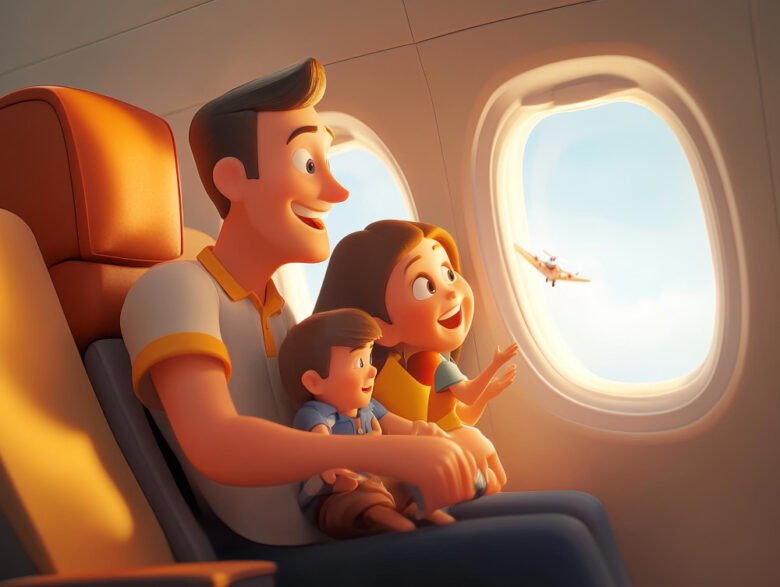
I’ll be honest with you: the week before our first flight with Claire, I Googled “flying with a baby” approximately forty times. I read every list, every forum thread, every horror story. I packed and repacked the diaper bag three times. I had a spreadsheet. An actual spreadsheet.
And then the flight happened, and about seventy percent of what I’d prepared was irrelevant, and the ten percent I hadn’t thought about nearly broke me. So here’s what I actually learned — not from a listicle, but from showing up at the gate with a four-month-old and figuring it out in real time.
What to Pack (the Honest Version)
Every packing guide will tell you to bring diapers. Obviously. What they won’t tell you is to bring roughly twice as many as you think you need, because delays are real and blowouts have no respect for your itinerary. For a two-hour flight, I brought eight diapers. I used five. I was glad I had the other three sitting there doing nothing.
Pack one change of clothes for the baby. Pack one for yourself too. I know that sounds dramatic. It isn’t. The day will come, and you will be grateful you read this.
For feeding, bring more formula or pumped milk than the flight duration requires. Account for the delay that may or may not happen, the extra feeding because the baby is stressed, and the one bottle you’ll drop on the floor of the terminal and have to throw out. If you’re nursing, great — you’re already ahead. If you’re using formula, pre-measure it into individual containers so you’re not fumbling with a scoop over a tray table at 30,000 feet.
The rest of the bag: wipes (more than you think), a pacifier with a clip so it doesn’t hit the floor every five minutes, one or two simple toys — a soft crinkle toy, a teether, something she can’t fling into the aisle — and a thin muslin blanket that doubles as a nursing cover, a sun shield, and a general comfort object. That’s it. Keep the bag light enough that you can actually carry it.
What to Dread (and Why It’s Never as Bad as You Think)
The crying. That’s what every new dad imagines: his baby screaming for two hours while rows of strangers silently judge his entire existence. I’m here to tell you it almost never plays out that way — and when it does, it’s survivable.
Claire fussed on takeoff. Probably twenty minutes of real unhappiness, which felt like four hours. I held her facing out, walked the aisle twice when the seatbelt sign was off, and offered her a bottle during the pressure change. She settled. A woman in the row behind us smiled and said her kids used to do the same thing. Nobody glared. Nobody said a word.
The ear pressure during takeoff and landing is worth paying attention to. Sucking helps equalize it — whether that’s nursing, a bottle, or a pacifier. Time the feeding to coincide with ascent and descent if you can. If your baby is asleep when the plane starts moving, don’t wake them; many babies sleep right through it without any trouble.
The diaper change on the plane is also something people build up into a nightmare. It’s awkward, yes. The bathroom is small, the changing table folds out of the wall like something from a submarine, and you will feel like you’re doing surgery in a phone booth. But it takes three minutes and then it’s done. Ask a flight attendant which bathroom has the changing table — not all of them do — and go when the aisle is clear.
Navigating the Airport With a Baby
Security is the part that stresses most parents out, and I get it. You’re juggling a baby, a diaper bag, a stroller, shoes, a laptop, and the quiet anxiety that you’ve somehow packed something you shouldn’t have. The trick is to slow down and organize before you get to the conveyor belt.
TSA allows formula, breast milk, and baby food through security in quantities exceeding the standard liquid limit. Just take them out and declare them when you reach the agent. They’ll screen them separately. No drama.
You’ll need to take the baby out of the carrier or stroller to walk through the scanner. Have the stroller folded and ready, or set it up for gate-check before you reach the belt. Gate-checking the stroller is almost always free and means you can use it right up until you board — which is worth a lot when you’re killing time in a terminal with a baby who needs to move.
Most airlines offer pre-boarding for families with young children. Use it. Every time. This isn’t a perk, it’s a survival strategy. Getting to your seat before the rush means you can actually set up — stow the bag, get the carrier ready, settle the baby — before 180 people are trying to squeeze past you in the aisle.
Lap Infant or Dedicated Seat?
Under two, babies can fly as lap infants on domestic flights at no extra charge (international flights usually involve a small fee, so check with your airline). It’s tempting to save the money, and for short flights, it’s completely manageable. Claire flew as a lap infant for the first two trips and it was fine.
That said, the safest option is always a dedicated seat with an FAA-approved car seat installed. If you’re flying with a car seat anyway, it’s worth buying the seat and using it — your baby is secured during turbulence, you have your hands back, and everyone is more comfortable. If you’re traveling light and it’s a short flight, the lap infant option works. Your call, your kid, your comfort level.
What to Embrace
Here’s the thing nobody tells you: babies under six months are actually pretty great travel companions. They sleep a lot. They don’t need entertainment. They don’t ask why the flight is delayed or demand to watch something on the iPad. Claire slept for most of our first flight and I sat there with a coffee, slightly stunned that it had gone that smoothly.
The other thing worth embracing is the small kindness you’ll encounter from strangers. Someone will hold the door at the gate. A fellow parent will catch your eye in the security line and give you a nod that says “I’ve been there.” A flight attendant will bring you a cup of water without you asking because they can see your hands are full. People are more decent than the internet wants you to believe.
And then there’s the moment you land, gather your things, strap the baby back into the carrier, and walk off the plane knowing you just flew somewhere with your kid for the first time. It’s a small thing, but it doesn’t feel small. It feels like evidence that life didn’t stop when Claire arrived — it just changed shape.
That’s worth something. Pack the extra diapers, breathe through the crying, and go.
The Bottom Line
Flying with a baby for the first time is one of those things that looks terrifying from the outside and turns out to be mostly manageable once you’re actually in it. You will overpack. You will stress about the crying. You will spend twenty minutes in a bathroom the size of a closet trying to change a diaper without touching anything. And then you will land, walk off that plane, and realize you did it.
The first flight is never really about the destination. It’s about proving to yourself that becoming a dad didn’t shrink your world — it just made the luggage heavier. Pack smart, lower your expectations for perfection, and remember that every parent on that plane has either been exactly where you are or will be someday.
Claire doesn’t remember that first flight, of course. But I do. I remember the way she fell asleep on my chest somewhere over the clouds, completely unbothered by the altitude or the noise or the fact that her dad was quietly terrified. She trusted me to figure it out. So I did.
You will too.

Dad. Engineer. Survivor of the first year. I’m James Calloway, and my daughter Claire is the reason I started writing. When she was born, I went looking for honest content written for dads — not parenting manuals, not diaper commercials, not advice from people who seem to have forgotten how hard the first year actually is. I didn’t find much. So I wrote it myself. The Dad Year is everything I wish someone had told me before that first night home. No expertise, no credentials — just a dad who took notes.