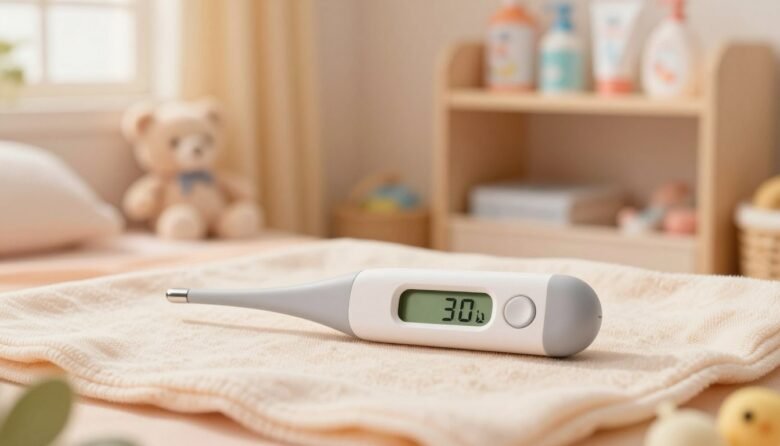
Claire ran her first real fever at nine weeks old. It was a Sunday night, obviously, because these things never happen on a Wednesday afternoon when the pediatrician’s office is open. She felt warm, she was fussier than usual, and I did what any reasonable dad does in that situation: I put the back of my hand on her forehead and tried to guess.
That is not a system. That is a dad pretending he has a system. What I actually needed was a thermometer — a good one, one I knew how to use, that I’d tested before that moment so I wasn’t reading the manual at 11 p.m. while my baby cried.
If you don’t have a thermometer yet, this is your reminder to get one before you need it. Here’s what you need to know.
Why It Actually Matters
For most adults, a fever is an inconvenience. For a baby under three months, a fever of 100.4°F or higher is a medical event that requires a call to your pediatrician — no waiting, no watching, no “let’s see how she is in the morning.” The threshold is that specific, which means you need a reading that’s actually accurate, not an approximation.
Beyond that first critical window, knowing your baby’s temperature helps you make decisions with confidence instead of anxiety. Is this a “give infant Tylenol and monitor” situation or a “call the doctor now” situation? A reliable thermometer gives you real information to work with. Guessing doesn’t.
The Types, Explained Simply
Rectal thermometers are the gold standard for accuracy in newborns and young infants. Pediatricians will often ask for a rectal temperature when you call about a fever in a baby under three months. It’s more invasive than other methods, but it gives the most reliable reading. If your baby is very young, this is worth having.
Temporal artery (forehead) thermometers use infrared to scan the forehead. They’re fast — a second or two — non-invasive, and work on a sleeping baby without waking them. Accuracy is good when used correctly, though it can be affected by sweat, ambient temperature, or poor positioning. This is what most parents reach for day-to-day.
Ear thermometers are also fast and reasonably accurate, but require correct positioning to work properly — you need to pull the ear back gently to align the sensor with the eardrum. They’re less reliable in babies under six months because the ear canal is still very small. More useful as your baby gets older.
Armpit (axillary) readings are the least accurate method. They’re better than nothing, but not by a huge margin. Don’t use armpit readings to make decisions about a young infant’s fever.
What to Actually Buy
My honest recommendation: own two thermometers. A rectal thermometer for the newborn stage — they’re inexpensive and you’ll use it when it really counts — and a forehead thermometer for everyday use as your baby gets older. You don’t need the same device to do both jobs perfectly.
For the forehead thermometer, look for a backlit display (you will be doing this in a dark room at 2 a.m.), a reading time under three seconds, and a fever alert — usually a color change or distinct beep that tells you at a glance whether the number is in normal range or not. Some models store recent readings, which is useful when you’re trying to track whether a fever is going up or down over a few hours.
You don’t need Bluetooth, an app, or a continuous monitoring patch. Those exist and some parents love them, but they’re well above the baseline. Get something accurate and simple first.
How to Use It Correctly
For a forehead thermometer: make sure your baby’s forehead is dry and at room temperature. Don’t check right after a bath, after they’ve been bundled under blankets, or after they’ve been outside in the cold. These will skew the reading. Scan across the forehead from the center to the hairline, following the manufacturer’s instructions for your specific model.
For a rectal thermometer: use a small amount of petroleum jelly on the tip, hold your baby securely on their back with their legs lifted, insert the tip no more than half an inch, and hold it in place until it beeps. It takes about ten seconds. Keep one hand on your baby the entire time.
Practice both before you need them under pressure. The first time you use a rectal thermometer should not be the night your baby has a fever and you’re terrified. Do a test run when everyone is calm.
When to Call the Pediatrician
Under three months: any temperature of 100.4°F or higher. Call immediately, day or night. This is not an overreaction — it’s the protocol, and it exists for good reason.
Three to six months: a fever of 101°F or higher warrants a call, especially if your baby seems unwell in other ways — not eating, difficult to console, unusually lethargic.
Over six months: most pediatricians want to hear from you if the fever hits 103°F, or if a lower fever persists for more than two or three days. When in doubt, call. That’s what they’re there for.
The Bottom Line
A good thermometer costs between twenty and fifty dollars. The peace of mind it gives you the first time your baby spikes a fever at midnight is worth considerably more than that. Buy it now, learn how to use it before you need it, and keep it somewhere you can find it in the dark.
The hand-on-forehead method is for grandparents. You have better options.

Dad. Engineer. Survivor of the first year. I’m James Calloway, and my daughter Claire is the reason I started writing. When she was born, I went looking for honest content written for dads — not parenting manuals, not diaper commercials, not advice from people who seem to have forgotten how hard the first year actually is. I didn’t find much. So I wrote it myself. The Dad Year is everything I wish someone had told me before that first night home. No expertise, no credentials — just a dad who took notes.